The Language Bridge: Understanding English Is Not the Same as Speaking It
Why comprehension can outpace speaking and why fluent speech can still be fragile.
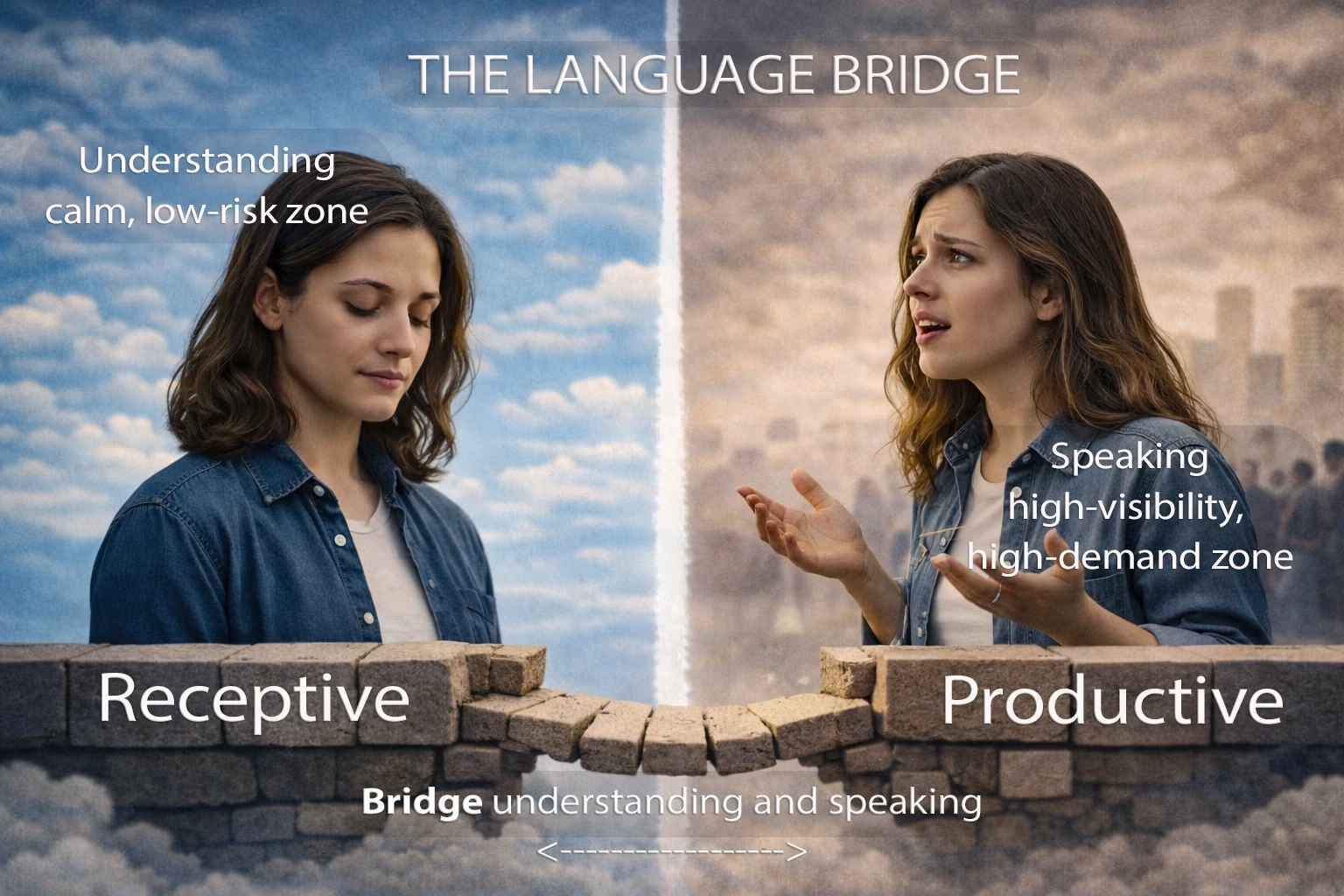
Understanding is receptive and low-risk; speaking is productive and requires real-time commitment.
If you can understand English but freeze when you speak, you’re not alone.
The problem is not that you “don’t know enough English,” but that understanding and speaking rely on different processes.
Understanding English is a receptive skill: you decode meaning without having to choose words yourself.
You can achieve full accuracy while staying completely silent, without any need to commit publicly to a response.
Speaking English, by contrast, requires you to select words, structure sentences, and commit to them in real time.
Once you speak, accuracy becomes visible, and errors become public.
The brain therefore prioritizes avoiding error over simply expressing meaning.
This response is cognitive, not emotional, and it affects learners at every level.
The Language Bridge: Why This Gap Develops
Many traditional courses build strong receptive skills far more than they train real-time production and decision-making.
As a result, learners often mistake strong comprehension for true speaking readiness.
Assessment systems often measure recognition more reliably than they do spontaneous production.
The Language Bridge: The Overlooked Reverse Pattern
But the opposite situation is also common, and often overlooked.
It is entirely possible, and quite common, to speak English fluently without fully understanding it.
This typically occurs when learners rely on memorized phrases, routines, and familiar contexts.
This type of fluency works well in predictable situations but breaks down when conditions change.
When contexts shift, this fluency provides limited support for new or more complex communication.
Here, fluency reflects surface competence rather than underlying linguistic control.
The Core Issue
Both patterns point to the same core issue: imbalance between receptive and productive skills.
CEFR-style frameworks and levels, such as those described in the Common European Framework of Reference for Languages (CEFR) , describe observable performance – what learners can do without always showing how stable or transferable those abilities are.
Real progress depends less on climbing levels and more on how well receptive and productive skills reinforce each other.
The Language Bridge: What Effective Speaking Practice Trains
From this perspective, your frustration is valuable information about how your learning has been structured so far.
What’s needed isn’t simply more input, but a different kind of practice.
It trains the ability to choose words, adapt on the fly, and keep speaking through uncertainty.
When receptive and productive skills align, speaking gains stability, flexibility, and reliability.
For learners, this means progress is more a question of training design than of personal ability.
Understanding this distinction allows learners to make more informed choices about how they train and assess their English.
What Effective Speaking Practice Trains
From this perspective, your frustration is valuable information about how your learning has been structured so far.
What’s needed isn’t simply more input, but a different kind of practice.
It trains the ability to choose words, adapt on the fly, and keep speaking through uncertainty.
This distinction also helps explain why placement results should be interpreted carefully. A placement test can indicate where a learner currently stands, but it cannot replace sustained speaking practice in real communicative conditions. (See our English placement test)
Likewise, developing stable speaking ability requires practice formats that actively engage production rather than passive recognition. (Explore our online English courses)
When receptive and productive skills align, speaking gains stability, flexibility, and reliability.
For learners, this means progress is more a question of training design than of personal ability.
Understanding this distinction allows learners to make more informed choices about how they train and assess their English.
TL;DR
- Understanding and speaking are different skills with different cognitive demands.
- You can understand well and still freeze when you speak—and you can speak fluently without deep understanding.
- Many courses and tests reward recognition more than real-time production.
- Speaking becomes stable when receptive and productive skills develop in alignment.
The Language Bridge: Frequently Asked Questions
- Why can I understand English but not speak it easily?
- Because understanding and speaking rely on different cognitive processes. Understanding is a receptive skill that involves recognizing words and meaning without time pressure. Speaking is a productive skill that requires choosing words and forming sentences in real time, where mistakes become visible.
- Is it normal to understand more English than I can say?
- Yes. Receptive skills such as listening and reading usually develop faster than productive skills like speaking. Understanding allows for accuracy without risk, while speaking requires commitment under uncertainty.
- Can someone speak English fluently without fully understanding it?
- Yes. Some learners speak fluently by relying on memorized phrases, routines, and familiar contexts. This type of fluency can sound confident, but it is often fragile and breaks down in unfamiliar or complex situations.
- Why do tests and levels sometimes not reflect speaking ability accurately?
- Many assessment systems measure recognition and observable performance more reliably than spontaneous production. As a result, they may show what a learner can do in familiar conditions without revealing how stable or transferable that ability is.
- Does studying more grammar or vocabulary improve speaking?
- Not by itself. Additional input can strengthen understanding, but speaking improves when learners practice making decisions in real time. Effective speaking practice trains word choice, adaptation, and continuation despite uncertainty, rather than only accuracy.
- What actually helps speaking develop?
- Speaking develops when receptive and productive skills are trained in alignment. This means practicing speech in a way that connects understanding to real-time use, allowing learners to adapt, clarify, and continue speaking even when language is imperfect.
- If I struggle to speak, does that mean I lack ability?
- No. Difficulty speaking is often a sign of how learning has been structured rather than a lack of ability. When training emphasizes understanding more than production, speaking hesitation is a predictable outcome.