CEFR and assessment
The CEFR Reality Check
How accurate are online English placement tests, and what does a CEFR-labelled result really tell us about someone’s ability to communicate?
CEFR levels such as B2 and C1 are widely used as shorthand indicators of English proficiency. These labels influence academic entry, recruitment, training decisions and professional expectations.
In online placement testing, however, a CEFR result is not a direct observation of everything a learner can do. It is an estimate produced from the skills, questions and scoring model included in that particular test.
The useful question is therefore not only “What level did the test assign?” It is also “What evidence supports that result, and how closely does it reflect observable communication?”
Key takeaways
Online placement tests are useful, but their CEFR results require careful interpretation.
- online tests may assign CEFR levels that exceed observable communicative performance
- misclassification can become particularly visible around the B2 threshold
- limited skill sampling can reduce sensitivity between neighbouring CEFR levels
- recognition-based questions cannot fully represent speaking, writing and interaction
- results are most useful when treated as evidence rather than unquestionable classifications
- observable communication should remain part of important placement decisions
The issue is not whether online testing has value. The issue is how confidently its results should be interpreted.
What the CEFR is
The CEFR is a descriptive framework, not a single universal testing method.
The CEFR provides shared descriptions of language ability from A1 to C2 so that levels can be discussed more consistently.
Its descriptors focus on what language users can understand and do in communicative situations.
Different tests may claim alignment with the CEFR while measuring different combinations of skills and knowledge.
A CEFR label only becomes meaningful when the evidence used to assign it reflects the ability being described.
Definition
What is CEFR inflation?
CEFR inflation describes a pattern in which assigned levels appear higher than the learner’s observable communicative performance would justify.
Limited productive-skill evidence
Broad categories at level boundaries
Heavy reliance on recognition tasks
Overconfidence in automated scoring
Mismatch with real communication
Expectations that exceed performance
The CEFR inflation effect
Why does misalignment become especially visible around B2?
Many learners can recognise substantial grammar and vocabulary while still differing considerably in fluency, control and interaction.
Short tests may struggle to distinguish reliably between stronger B1, emerging B2 and established B2 performance.
At higher levels, distinctions increasingly involve how flexibly and effectively language is used, not only how much language is recognised.
A wide range of different learner profiles may be grouped under the same B2 label despite meaningful differences in communicative effectiveness.
Why misalignment matters
An inaccurate level affects more than the number shown on a result page.
Learner expectations
Over-placement can create frustration when the learner is asked to perform tasks that remain beyond their current ability.
Course placement
An inflated result can place someone in material that assumes skills and control they have not yet developed.
Professional decisions
Employers and institutions may expect a level of communication that the test result does not fully support.
Trust in CEFR labels
Repeated overestimation weakens the value of the level system by making labels less consistent and informative.
A practical framework
Four criteria can help us judge whether CEFR placement evidence is credible.
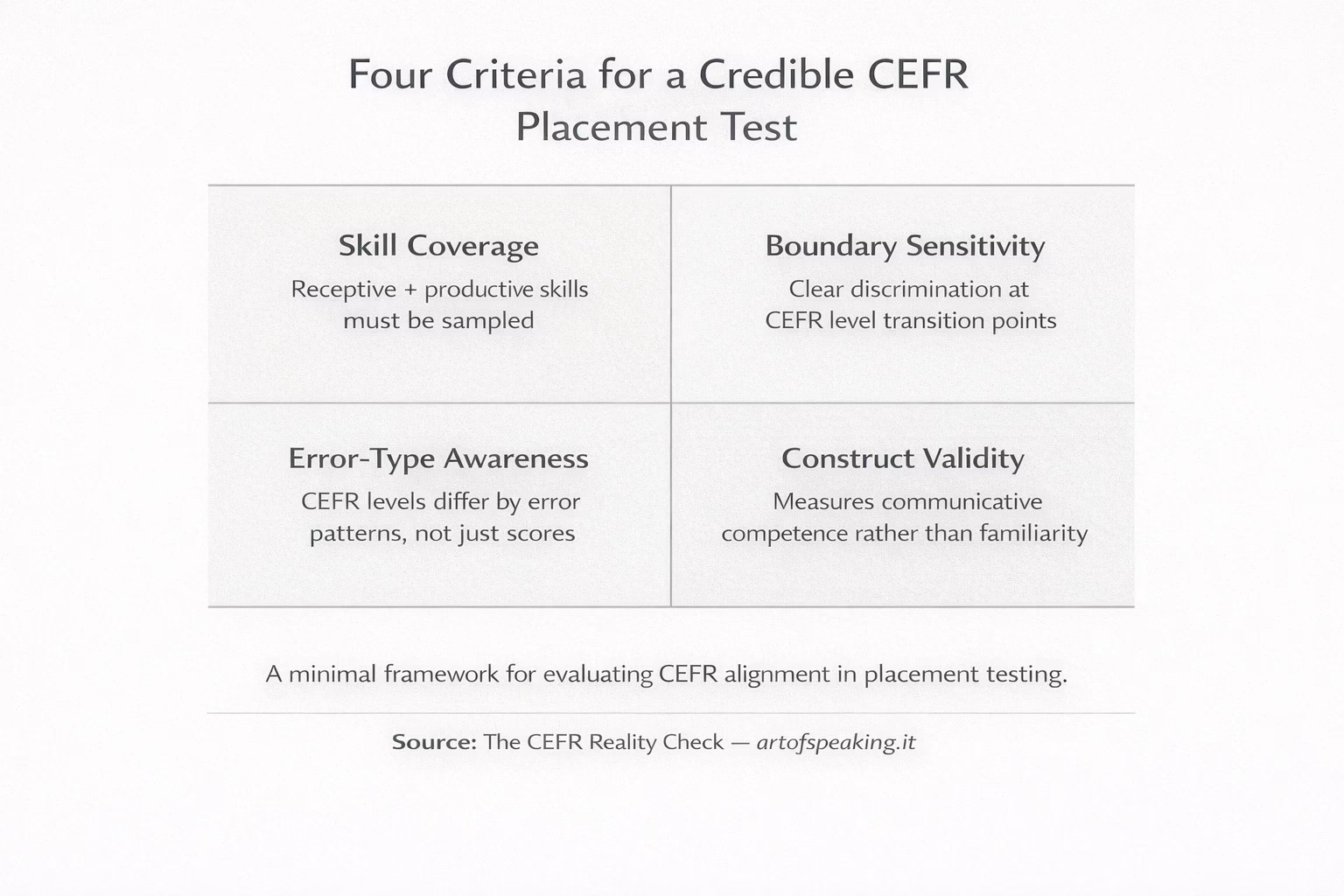
Note: This framework presents a minimal set of observable criteria for interpreting CEFR alignment in placement testing. It is not intended as a complete validation protocol.
Press-safe summary
An independent analysis of CEFR alignment in online placement testing.
The CEFR Reality Check examines how CEFR levels are assigned in online English placement tests and how those assignments compare with observable communicative performance.
The analysis highlights recurring patterns in which automated tests may assign levels that exceed functional ability, particularly around the B2 threshold.
Rather than evaluating or ranking individual providers, the project proposes a minimal framework for interpreting CEFR-labelled results and supporting more informed decisions by learners, educators and institutions.
Common questions
Questions about the CEFR Reality Check.
It is an independent analysis of how CEFR levels are assigned in online English placement tests and how those assignments compare with observable communicative performance.
No. It focuses on recurring structural patterns rather than evaluating individual providers or products.
It describes a systematic tendency for placement tests to assign higher CEFR levels than observable communicative performance would justify.
It is a pattern in which a wide range of intermediate learners are grouped at B2 despite meaningful differences in fluency, control and communicative effectiveness.
No. The analysis distinguishes between the CEFR as a reference framework and the ways in which individual tests operationalise it.
Further questions
How should online placement results be interpreted?
Higher CEFR levels depend increasingly on qualitative distinctions in productive skills that short automated tests may find difficult to infer.
They can be useful for accessibility and initial orientation, but their results should normally be treated as indicative estimates rather than definitive classifications.
It is intended for learners, educators, institutions and decision-makers who use CEFR-labelled placement results.
It presents a minimal framework for evaluating whether CEFR placement results are supported by appropriate evidence.
CEFR levels remain valuable when they are grounded in observable communication and interpreted with an understanding of what a particular test can and cannot measure.
Conclusion
Online placement tests are valuable tools, but CEFR-labelled outputs need context.
Online English placement tests support accessibility and scalability, but their results must be interpreted according to the evidence they actually collect.
Misalignment is often structural. It can arise from limited skill sampling, reduced sensitivity at level boundaries and attempts to infer productive ability from recognition-based tasks.
Recognising these limitations does not weaken the CEFR. It helps preserve the framework’s value by grounding level decisions in observable communicative performance.
Continue exploring
Understand the framework before relying on the label.
Explore the full CEFR level system, examine what B2 means in professional contexts, and treat placement results as useful evidence that still requires interpretation.